29 de mar. de 2019

13 Highest Paying URL Shortener: Best URL Shortener to Earn Money

  1. BIT-URL

    It is a new URL shortener website.Its CPM rate is good.You can sign up for free and shorten your URL and that shortener URL can be paste on your websites, blogs or social media networking sites.bit-url.com pays $8.10 for 1000 views.
    You can withdraw your amount when it reaches $3.bit-url.com offers 20% commission for your referral link.Payment methods are PayPal, Payza, Payeer, and Flexy etc.
    • The payout for 1000 views-$8.10
    • Minimum payout-$3
    • Referral commission-20%
    • Payment methods- Paypal, Payza, and Payeer
    • Payment time-daily

  2. Ouo.io

    Ouo.io is one of the fastest growing URL Shortener Service. Its pretty domain name is helpful in generating more clicks than other URL Shortener Services, and so you get a good opportunity for earning more money out of your shortened link. Ouo.io comes with several advanced features as well as customization options.
    With Ouo.io you can earn up to $8 per 1000 views. It also counts multiple views from same IP or person. With Ouo.io is becomes easy to earn money using its URL Shortener Service. The minimum payout is $5. Your earnings are automatically credited to your PayPal or Payoneer account on 1st or 15th of the month.
    • Payout for every 1000 views-$5
    • Minimum payout-$5
    • Referral commission-20%
    • Payout time-1st and 15th date of the month
    • Payout options-PayPal and Payza

  3. Linkbucks

    Linkbucks is another best and one of the most popular sites for shortening URLs and earning money. It boasts of high Google Page Rank as well as very high Alexa rankings. Linkbucks is paying $0.5 to $7 per 1000 views, and it depends on country to country.
    The minimum payout is $10, and payment method is PayPal. It also provides the opportunity of referral earnings wherein you can earn 20% commission for a lifetime. Linkbucks runs advertising programs as well.
    • The payout for 1000 views-$3-9
    • Minimum payout-$10
    • Referral commission-20%
    • Payment options-PayPal,Payza,and Payoneer
    • Payment-on the daily basis

  4. Clk.sh

    Clk.sh is a newly launched trusted link shortener network, it is a sister site of shrinkearn.com. I like ClkSh because it accepts multiple views from same visitors. If any one searching for Top and best url shortener service then i recommend this url shortener to our users. Clk.sh accepts advertisers and publishers from all over the world. It offers an opportunity to all its publishers to earn money and advertisers will get their targeted audience for cheapest rate. While writing ClkSh was offering up to $8 per 1000 visits and its minimum cpm rate is $1.4. Like Shrinkearn, Shorte.st url shorteners Clk.sh also offers some best features to all its users, including Good customer support, multiple views counting, decent cpm rates, good referral rate, multiple tools, quick payments etc. ClkSh offers 30% referral commission to its publishers. It uses 6 payment methods to all its users.
    • Payout for 1000 Views: Upto $8
    • Minimum Withdrawal: $5
    • Referral Commission: 30%
    • Payment Methods: PayPal, Payza, Skrill etc.
    • Payment Time: Daily

  5. CPMlink

    CPMlink is one of the most legit URL shortener sites.You can sign up for free.It works like other shortener sites.You just have to shorten your link and paste that link into the internet.When someone will click on your link.
    You will get some amount of that click.It pays around $5 for every 1000 views.They offer 10% commission as the referral program.You can withdraw your amount when it reaches $5.The payment is then sent to your PayPal, Payza or Skrill account daily after requesting it.
    • The payout for 1000 views-$5
    • Minimum payout-$5
    • Referral commission-10%
    • Payment methods-Paypal, Payza, and Skrill
    • Payment time-daily

  6. LINK.TL

    LINK.TL is one of the best and highest URL shortener website.It pays up to $16 for every 1000 views.You just have to sign up for free.You can earn by shortening your long URL into short and you can paste that URL into your website, blogs or social media networking sites, like facebook, twitter, and google plus etc.
    One of the best thing about this site is its referral system.They offer 10% referral commission.You can withdraw your amount when it reaches $5.
    • Payout for 1000 views-$16
    • Minimum payout-$5
    • Referral commission-10%
    • Payout methods-Paypal, Payza, and Skrill
    • Payment time-daily basis

  7. Short.pe

    Short.pe is one of the most trusted sites from our top 30 highest paying URL shorteners.It pays on time.intrusting thing is that same visitor can click on your shorten link multiple times.You can earn by sign up and shorten your long URL.You just have to paste that URL to somewhere.
    You can paste it into your website, blog, or social media networking sites.They offer $5 for every 1000 views.You can also earn 20% referral commission from this site.Their minimum payout amount is only $1.You can withdraw from Paypal, Payza, and Payoneer.
    • The payout for 1000 views-$5
    • Minimum payout-$1
    • Referral commission-20% for lifetime
    • Payment methods-Paypal, Payza, and Payoneer
    • Payment time-on daily basis

  8. Cut-win

    Cut-win is a new URL shortener website.It is paying at the time and you can trust it.You just have to sign up for an account and then you can shorten your URL and put that URL anywhere.You can paste it into your site, blog or even social media networking sites.It pays high CPM rate.
    You can earn $10 for 1000 views.You can earn 22% commission through the referral system.The most important thing is that you can withdraw your amount when it reaches $1.
    • The payout for 1000 views-$10
    • Minimum payout-$1
    • Referral commission-22%
    • Payment methods-PayPal, Payza, Bitcoin, Skrill, Western Union and Moneygram etc.
    • Payment time-daily

  9. Adf.ly

    Adf.ly is the oldest and one of the most trusted URL Shortener Service for making money by shrinking your links. Adf.ly provides you an opportunity to earn up to $5 per 1000 views. However, the earnings depend upon the demographics of users who go on to click the shortened link by Adf.ly.
    It offers a very comprehensive reporting system for tracking the performance of your each shortened URL. The minimum payout is kept low, and it is $5. It pays on 10th of every month. You can receive your earnings via PayPal, Payza, or AlertPay. Adf.ly also runs a referral program wherein you can earn a flat 20% commission for each referral for a lifetime.
  10. Wi.cr

    Wi.cr is also one of the 30 highest paying URL sites.You can earn through shortening links.When someone will click on your link.You will be paid.They offer $7 for 1000 views.Minimum payout is $5.
    You can earn through its referral program.When someone will open the account through your link you will get 10% commission.Payment option is PayPal.
    • Payout for 1000 views-$7
    • Minimum payout-$5
    • Referral commission-10%
    • Payout method-Paypal
    • Payout time-daily

  11. Linkrex.net

    Linkrex.net is one of the new URL shortener sites.You can trust it.It is paying and is a legit site.It offers high CPM rate.You can earn money by sing up to linkrex and shorten your URL link and paste it anywhere.You can paste it in your website or blog.You can paste it into social media networking sites like facebook, twitter or google plus etc.
    You will be paid whenever anyone will click on that shorten a link.You can earn more than $15 for 1000 views.You can withdraw your amount when it reaches $5.Another way of earning from this site is to refer other people.You can earn 25% as a referral commission.
    • The payout for 1000 views-$14
    • Minimum payout-$5
    • Referral commission-25%
    • Payment Options-Paypal,Bitcoin,Skrill and Paytm,etc
    • Payment time-daily

  12. Shrinkearn.com

    Shrinkearn.com is one of the best and most trusted sites from our 30 highest paying URL shortener list.It is also one of the old URL shortener sites.You just have to sign up in the shrinkearn.com website. Then you can shorten your URL and can put that URL to your website, blog or any other social networking sites.
    Whenever any visitor will click your shortener URL link you will get some amount for that click.The payout rates from Shrinkearn.com is very high.You can earn $20 for 1000 views.Visitor has to stay only for 5 seconds on the publisher site and then can click on skip button to go to the requesting site.
    • The payout for 1000 views- up to $20
    • Minimum payout-$1
    • Referral commission-25%
    • Payment methods-PayPal
    • Payment date-10th day of every month

  13. Short.am

    Short.am provides a big opportunity for earning money by shortening links. It is a rapidly growing URL Shortening Service. You simply need to sign up and start shrinking links. You can share the shortened links across the web, on your webpage, Twitter, Facebook, and more. Short.am provides detailed statistics and easy-to-use API.
    It even provides add-ons and plugins so that you can monetize your WordPress site. The minimum payout is $5 before you will be paid. It pays users via PayPal or Payoneer. It has the best market payout rates, offering unparalleled revenue. Short.am also run a referral program wherein you can earn 20% extra commission for life.

ORBAT - Soviet Divisional Units, Part 2 MRD Artillery Regiment


This post looks at Artillery support within the Division and specifically at the composition of the Divisional Artillery Regiment, how the capability changed over the period and how it might be represented within games and scenarios.

The organic components of Divisional Artillery units were  broadly consistent across both the MRD and TD however their detailed composition varied, these Artillery units included:
  • Artillery Commander and his Staff
  • Artillery Regiment
  • Frog Battalion
  • Anti Tank Battalion (not in TD)
  • Artillery Battalions of subordinate MRR/TRR
Whilst in other armies air defence would be a component of the Artillery in the Soviet Ground Forces this was a separate arm of Service.  The Anti Tank Battalion's deployment and grouping have been considered in an earlier post and I'll leave the Frog Battalion for another day.


Equipment and Organisational Change

The composition of the Divisional Artillery Regiment and the amount of organic artillery available to the Division varied significantly over the period from the 1970s through to the end of the 1980s and whilst my focus is on the 1980s it's worth understanding this as it accounts for a variety of conflicting information presented across the various sources which can lead to confusion if the general pattern of transition is not understood.
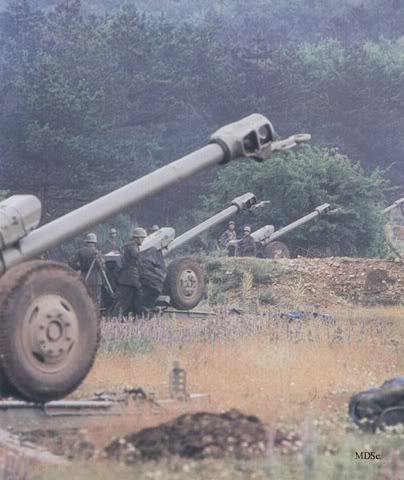

In the 1970's the MRD's Artillery Regiment comprised two battalions of towed 122mm D30 Howitzers  and 1 battalion of towed 152mm D1/D20 guns, in a TD this was 3 Battalions of towed 122mm D30 guns. Each regiment included 3 Batteries of 6 Guns and most units used trucks as the gun tractors.

By The end of the Cold War units would have an Artillery Regiment equipped with self propelled guns, in MRD's this could include 3 battalions of 2S3, in TD's 2 battalions of 2S3 were more likely.  In both cases batteries were of 8 guns and the regiments included an MLRS Battalion also of 3 batteries of 8 Launchers. The 8 gun and 8 launcher batteries seem to have been largely confined to GSFG.
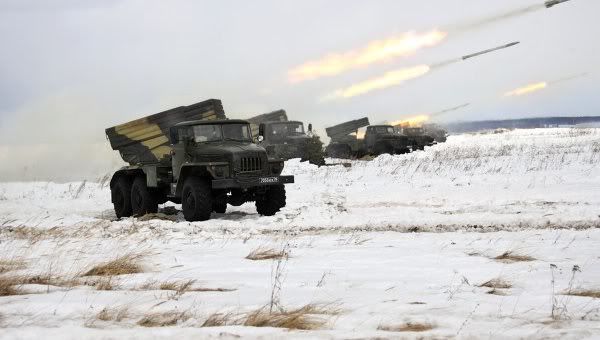

The MLRS units were incorporated into the divisional Artillery Regiments in the mid 70s and 2S1 and 2S3 started to be introduced to replace the towed guns and howitzers from around 1973.  As individual Regiments transitioned from the D30/1/20 /MLRS mix through the introduction of initially a mix of 2S1 and 2S3 and then to all 2S3 units this created the conditions for a variety of Orbats to exist within the divisions of any particular Army or Front at a given point in time.  The limiting factors on the transition and the principal cause of the variability being the rate of production and the sheer size of the Soviet ground forces, of note 2S3 production did not complete until 1993.


The broad roll out following acceptance in 1971 as outlined by Zaloga was:
  • From 1973 1 2S3 battalion to each MRD Artillery Regiment: A MRD could include 2 D30 battalions and 1 2S3 battalion
  • From 1973 1 2S1Bn to each Cat 1 TD: A TD Could include 12S1 and 2 D30 battalion 
  • From mid 70s 1 122mm D30 battalion was replaced by 2S3 in TDs: TDs could include 1 2S1, 1D30 and 1 2S3 Bn 
  • Cat 1 MRD received 6 battalions of 2S1 two in the Artillery Regiment and 1 in each of the maneuver regiments:  MRD Artillery Regiments could have a composition of 2 2S1 battalions and 1 D1/20 or 2S3 battalion. (this also rather defeats the view of BMP units having 2S1 battalions and BTR units having D30 equipped battalions)
  • Cat 1 TD received 6 battalions of 2S1 taking them to 3 2S1 battalions or 2 2S1 and 1 2S3 battalion. 
  • Additional 2S3 battalions were deployed releasing 2S1 Battalions to the maneuver regiments
  • All this did not happen as a simple sequence and the different policies and deployments interacted with each other unpredictably.

So what does this mean from the Wargames perspective, there were a lot of options, it was a big army, the role out did not complete before the economic impacts at the back end of the Cold war began to hit.  You have a lot of choice, my late period Divisional Artillery Regiment has one 2S1 battalion and two 2S3 battalions. For operations the Soviet Army task organised units into Artillery Groups which introduced a lot more variation and are discussed further below.

The weapons thrown up by these changes were re used, initially they increased the Regimental artillery from a battery to a battalion and as towed assets in these units were replaced with Self propelled platforms then the size of Army and Front Artillery brigades were increased. The quantity of organic Artillery in the division including the regimental Artillery units therefore increased from a likely minimum 78 Guns in the 70's to  a maximum 192 guns by the end of the Cold War.


The broad equipment change time line over the period with respect to Artillery equipment looks like this:
  • 1963 D30
  • 1966 PSNR 1 Ground Surveillance Radar
  • 1971 2S3 entered production
  • 1972 2S1 entered production
  • 1973 first deliveries 2S1/2S3
  • 1974 ACRV IV 12 Series Vehicles
    • IV13 Battery fire direction centre, 
    • IV 14 Battery Command Vehicle with PN44 night sight and D11M-1 Laser range finder,
    • IV15 Battalion Command vehicle with additional radios, 
    • IV16 battalion Fire Direction Centre with Field Artillery computer
  • 1975 SNAR 10 Target detection and fire adjustment
  • 1975 PRP 3 with PN 61 Image Intensifier, D11 Laser Range Finder, IV 520 Fire Control , Computer, dismountable D13 LRF (I think this came later), RL 126 ground surveillance radar
  • 1975 2S3M upgraded loader increased rate of fire
  • 1976 PSNR-5
  • Late 70s DK-1 Dismountable LRF Sage Gloss at Regiment and Division
  • 1980's 9M28 Rocket Grad P (Airburst)
  • 1980 PRP 4 as PRP3 but with PN 71 Thermal Imager a D14 LRF and PSNR -5 ground Surviellance radar
  • 1983 ACRV upgrade
  • 1986 152mm PGM 2K25 Krasnopol complex deployed by 2S3. The 122mm Kitalov 2 complex was a post Cold War system deployed in 2002
  • 1987 2S3M1 Gunsight and data terminal to receive display command information from IV 13
  • 1988 PRP 4M

So not dissimilar to Western developments with the principal areas of change being:
  • The Introduction of Self Propelled Guns.
  • The Introduction of dedicated Command and Observation Post vehicles specifically equipped for role.
  • The development, deployment and improvement of target acquisition systems including radars, lasers, and night observation systems.
  • The development, deployment and improvement conventional munitions to include PGMs and sub munitions.
  • The development and deployment of data systems for processing and passage of command and fire control data.


A wide range of munitions were available for both 122mm and 152 gun systems for the 2S3 these included:
  • OF-540 HE
  • OF-25 HE Frag
  • BP-540 HEAT-FS
  • Br-540B AP-T
  • OF-38 Krasnopol Laser Guided
  • S1 Illuminating
  • ZH3 Smoke
  • and Nuclear Warheads with a 2kt yeild


The impact of all these changes were quite considerable in terms of the effectiveness of Soviet Artillery the impacts included;
  • Increased protection of the gun crews, 
  • More rapid displacement between fire positions, 
  • Reduced time into and out of action, 
  • Improved target acquisition 
  • Increased range, of munitions and target acquisition capability
  • Reduced time to resolve targets at greater ranges
  • Increased speed of transmission of artillery data reducing engagement times and data errors.
  • Increased speed of processing fire missions, through use of fire control computers
  • Improved Lethality, both through munitions developments higher rates of fire and the increase in size of the fire unit from battery to battalion.
These increases in the scale efficiency and overall destructiveness of Soviet Artillery over the period and acted as a significant counter to NATO proliferation of handheld anti tank weapons and enabled the Soviet Army to reduce its doctrinal dependence on nuclear weapon use.

The Divisional Artillery Regiment

The Organisation of the Divisional Artillery Regiment is outlined in the diagrams below, TD's would generally only deploy two battalions of 2S3.  Both Isbey and FM 100-2-3 contain detail on the composition of the various Sub Units.
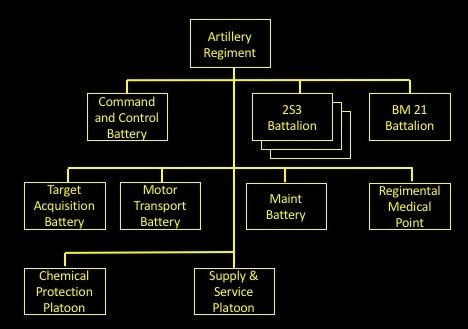


From a Wargames perspective the main elements that we might want to represent will be rules dependent, from my point of view these are:
  • Command and Control Battery
  • 2S3 Battalions
  • BM 21 Battalion
  • Target Acquisition  Battery
  • Regimental Aid Point
The gun battalions and BM 21 battalions are  broadly similar organisation and include:


For my games I use a vehicle scale of 3:1 so I represent the battalion as 3 batteries with each battery containing:

  • A supply truck, either a Zil 131 or a URAL 4275, 
  • A command vehicle either an IV 12 Series COP/FDC (2 batterys per battalion) or a BTR 60 PU radio vehicle (1 battery per battalion and effectively representing the Battalion HQ). 
  • 2 firing platforms 2S1/2S3 or MLRS depending on the unit type.  
From the battalion I deploy two OPs using the ACRVs as theoretically this organisation could generate seven OPs if required:

  • 4 from the COPs (IV13/15) 
  • 1 from the PRP 
  • 2 additional flanking OPs which would be created on an Ad Hoc basis from battery staff and vehicles.
The Regimental Command and Control Battery


A BTR 60 Command Wagon represents the 3 ACVs admittedly 2 are MTLBus but I have a lot of them in the unit already. Other than that I have added 1 UAZ 469 and 1 Gaz 66.  I also included a PRP 3 which might seem a bit strange.  

One of the things I wanted to resolve within the HQ was the representation of PRP 3. Because of the way the PRPs are distributed with three sitting  in the Regimental Artillery battalions (one each) and three in the divisional Artillery battalions (one each) and one in the Target Acquisition Battery.  You end up with no representation of the vehicle due to the 3:1 vehicle scale, which is a shame as its a good looking wagon. Technically two would be deployed within the division (at 3:1) to accommodate this I added one to the Regimental HQ and one to the Target Acquisition Battery

The Target Acquisition Battery


It's a bit of a challenge to work out what's going on here and with this organisation having components that would sit in the off board force and the onboard force it needs to be divided up.  This is how I viewed it;
  • Recce Platoon @ 2 BTR 60/70/80 + 2 LRF - represented by 1 BTR 60
  • Comms Platoon @ 1 UAZ 452 Compute, 3 UAZ 469, 3 Gaz 66 - 1 UAZ 469, 1 Gaz 66
  • Surveillance Radar Platoon @ 1 SNAR 10, 1 PRP3, 1 Counter Mortar Radar - represented by 1 SNAR 10, 1 PRP 3 (see above for explanation).  The SNAR 10 would normally be deployed along side Artillery COPs.
  • Sound Ranging Platoon @ 4 Gaz Vans, This example of the 1B19 Complex provides a view - 1 Van
  • Topo Survey Platoon - not represented
  • Met Survey Platoon - not Represented
  • Radar Platoon - 3 radar direction finder, 3 Gaz 66 - 1 Gaz 66 and a PSNR -1 or 5
So In Summary 1 BTR 60 ACV, 1 UAZ 469 & Gaz 66, 1 SNAR 10, 1 GAZ VAN, 1 GAZ 66 + Radar.  I have found no source data that attributes the number of vehicles to the platoons within the Target Acquisition Battery so have applied some thought and generated the answer. If anyone knows of better data on this I would be grateful for any pointers as to a more accurate representation. 


Regimental Medical Point


FM 100-3-2 covers the Regimental Medical Point under the MRR and I have assumed its the same for all regiments.  The core of this is a treatment section and one or two collection sections. I assume of the four Ambulances available three are in the collection section and one in the treatment section and the other sections all collocate with the treatment section. I have gone for a three vehicle representation of a Gaz 66 for the Treatment section and 1 UAZ 452 for each collection section.


Krasnopol

Krasnopol was a Precision Guided Munition(PGM) for 152mm Artillery pieces deployed in the late 80s. PGM's effectively allowed artillery firing in the indirect fire role to engage point targets such as vehicles or field defences.  This was achieved through laser target marking and steerable control surfaces on the projectile allowing for in flight course correction.  The amount of correction possible  was limited so the round had to be lobbed into the right space relative to the target and the observer for the whole thing to work. Rounds were provided for all the major 152mm systems in Soviet service. The complex consisted of the OF 39 projectile and a D15 Laser Target Designator together with a couple of command devices one for the gun line and 1 for the OP.
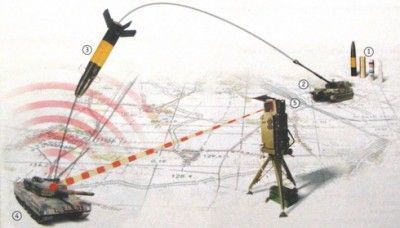

Getting the round in the right place at the right time from the right direction to acquire the illuminated target was critical to success, as was the need to limit the time the target had to react. All this required a degree of thought to be applied to the process, as such engagement zones needed to be recced and engagements planned. This required a degree of preparation of the target zone and the gun line which would improve hit probability and reduce the effectiveness of any target counter measures.  Clearly more Ad Hoc engagement would lead to a lower probability of hit.
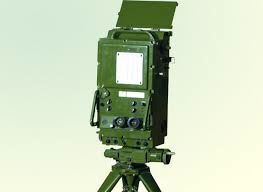


Krasnopol was allocated in sets, each set included;
  • 50 Rounds 
  • The shot synchronization system
  • The LTD.  
A battalion might be allocated 4 sets for a total of 200 rounds.  Common practice seemed to allocate one battery as the Krasnopol Battery and one platoon within that battery as the Krasnopol Platoon .  This platoon would carry 140 of the 200 rounds with the remainder being spread across the rest of the battalion. One LTD would go to each Battery COP and 1 to the Battalions mobile reconnaissance post (PRP 3).

In order to engage the OP had to position between the target and the gun line within a 15 degree arc and within 7kms of the target.  Rounds would be fired in succession into the target area either on command of the OP or every 30 seconds.

Krasnopol seems like very useful addition to the indirect fire inventory of the Divisional Artillery Regiment and one which makes the deployment of the related COPs a consideration from both a task organisation perspective and enabling targets to be engaged. I can think of a number of scenarios where It would be interesting to explore the impact of this such as the deployment of the Anti Armour Reserve at divisional or regimental level and the deployment of the Advance Guard.


Artillery Groups and Control of Fires and Units


With the Artillery assets at its disposal the division artillery staff would form a Divisional Artillery Group (DAG) and a number of Regimental Artillery groups (RAG).  The Division would be allocated assets from Army and Front and allocate assets to its subordinate Regiments enhancing the organic capability.

RAGs would generally only be composed for the units in the first echelon. The implication from the Xenophon lessons on Divisional Artillery is that all the divisions artillery assets would be allocated between the DAG and the first echelon RAGs. RAGs for the 2nd echelon units would be composed prior to that echelon being committed effectively being withdrawn from the first. The staff planning data for these add hoc groups were:
  • DAG 4-6 Units
  • RAGs 3-4 Units (For lead Echelons only)
Clearly these would be impacted by the priority of the axis of advance (main or secondary) and the type of operation, advance, breakthrough or pursuit.


Battalions would be allocated fire units from RAG as required this would generally be when acting as an advanced Guard, Forward detachment or for an assault. The composition and distribution of non organic assets has been covered in earlier posts on the MRR and Non Divisional Artillery Units which contain examples of such groupings and provide a view on the range of units from which these elements might be drawn.

In addition reinforcing fire from the Army Artillery Group and the Front Artillery Group could be superimposed by the higher headquarters as it saw fit or as part of a fire plan.

Groupings and hence control of the Artillery units would change with the different phases of the Plan.  In general the DAG would retain control in the preparatory fire phase, then resources and control would shift to the RAGs for the Assault phases before being transferred to the 2nd Echelon as they were committed.  Fire Units Ammunition and Time slots could all be held in reserve.

I aim to explore this further in a TTP post about the deployment and use of divisional artillery after I have digested some more of the data in the Xenophon archive.
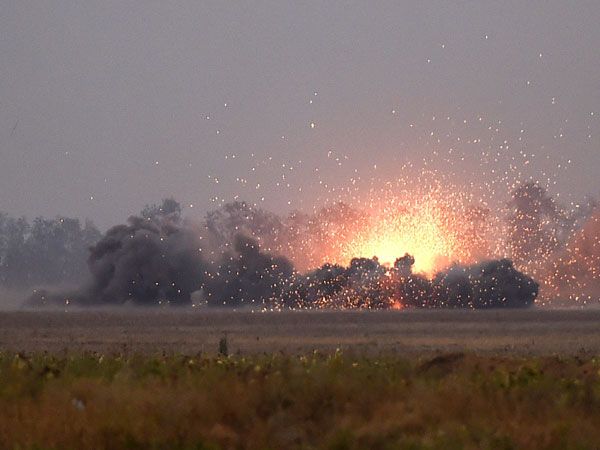


Wargames Representation

Whilst the Divisional Artillery Regiment does not easily lend itself to most peoples idea of a 20mm table top action there are a number of ways its assets can be included in games, although I do admit that you have to try hard. There are a number of mechanisms which allow exploration of their use and role, these include;
  • Direct incorporation into the onboard elements as a focus of the scenario an example might be penetration of NATO forces into the depth of the divisional defence where Reserves and Artillery elements might be the core components of the Soviet Force. Such games can be built as stand alone scenarios or be components of a mini campaign.
  • Representation as off board support providing the Divisional wrap of supporting fires and Air Defence, in this instance the elements needing to be represented would be limited to on board Target Acquisition components.   
  • Representation on subsidiary boards enabling aspects of the depth fire battle to play out using Air, Artillery, Air Defence and follow on Maneuver assets as part of a larger game. Personally I like this approach and a variety of additional commands can be generated around the Artillery, Air and Air Defence aspects allowing examination of both deep and rear operations, both of which had significant impact on the outcome of the engagement being fought.  Without additional players the scope is more limited as there is a significant amount of thinking needed and additional game mechanics to play through that would otherwise consume too much time.
  • Linked Games, pre game play and mini campaigns offer approaches to resolving the issues outlined in the subsidiary board approach and if the number of players are limited offer a way to explore elements of Deep and Rear opps.  The detail of the sequencing of the games then becomes the major challenge.
  • Smaller Scale, heresy so not considered further :). Not my particular poison but alternative scales 1:300/600/700 offer the opportunity to develop these aspects in a more manageable space both from a cost and storage perspective, my problem is I am far to in love with the joys of 20mm to go there.
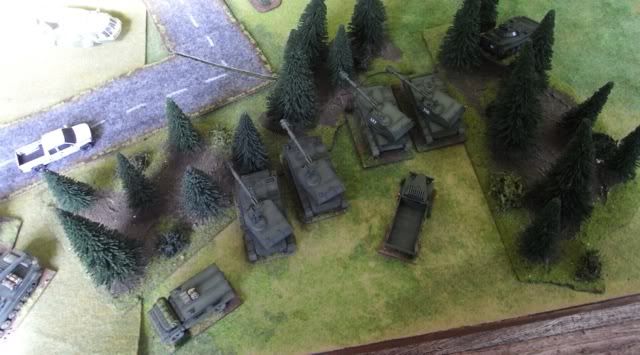


What gets represented and how the support is applied is a key component of designing the scenario and something for the TTP post and some scenario ideas I have been working on.  Both the Big games covered on the blog the Wisenberg Counterattack and Storming the Weidhouse Gap contained significant artillery components. 

Models and Availability

Having identified that you want to build something as challenging as an Artillery Regiment and you have managed to convince your self that it will get the odd outing. Sourcing the models isn't always easy, the table below outlines a range of suppliers for the vehicles required to represent in whole or part the Divisional Artillery Regiment.


Whilst the coverage of the vehicle fleet is fairly complete now with the release of conversion sets by S&S for the BTR series vehicles some of the ground equipments will require scratchbuilding if they are to be represented, notable ones include:
  • Counter Battery Radars
  • D15 Laser Target Designator
  • DK-1 Laser Range Finder (Imagery of this is proving a challenge to find)
where I have already written a review of the relevant models they can be found here:


References:

Books:
Internet:
Other Posts of Interest


God I Love Subquark Games!

Whats going  on everyone!?


Today for the #2019gameaday challenge I grabbed one of my favorite GOTG games, Mint Tin Pirates from one of my all time favorite game publishers, Subquark Games!


Of course my lovely wife won the game but that doesn't make this game any less enjoyable. 


I can honestly say that I have grown to expect to have their line of games with me wherever I go. By far my favorite games for travel and nearly a must!


As always, thank you for reading and don't forget to stop and smell the meeples! :)

-Tim

GTA 5 Compressed


GTA 5 compressed ( 36 GB).7z


File Size- 8.79 MB
Uploaded Date- 1/12/2017


This is gta 5 game which is compressed by Gaming Expert. 

ePSXe Bios File

Download ePSXe Bios File

28 de mar. de 2019

Agricola Review

When I first got into board gaming, Agricola was the game.  But it looked complicated.  I read the rules online, but didn't get much out of them.  Then I tried it out at a convention, borrowing it from the library.  But you know how library copies of games can be.  Whoever played it last just unceremoniously dumped all the pieces back in the box helter skelter.  So after an hour of sorting everything back out and setting up the game, I got half an attempt in with it, then we had to quit.  I tried again the next day, and this time someone taught us how to play.  Then they left us in the dust.

To put it bluntly, my initial experiences with Agricola did not endear me to the game.  However a nugget of affection stuck with me.  So much so that years later when I was looking for a heftier worker placement game than Lords of Waterdeep or Stone Age, I came back to Agricola.  This time around, my experience has been much better, and it's now one of my favorite games.

Agricola was released in 2007 by Z-Man Games, and was designed by Uwe Rosenberg.  It's a worker placement game that tasks you with building up your farm, and not starving.  Players will have to plow fields and plant crops, raise animals, and build additions onto their house in order to grow their family.  In the midst of all this, you also need to feed your family at an increasing pace.
Read more »

Review - Book, Todays Army Air Corps, Paul Beaver, 1987


The first thing to point out about what I think is a very handy little reference is that the title is a complete misnomer.  Written in 1987 the Today in the title very much refers to the Army Air Corps of yesterday and you will certainly struggle to find even a mention of the AH 64 which was a distant aspiration at the time of writing.  What the book does do well is provide a compact overview of the British Army Air Corps This includes:
  • A Short History of Army Flying
  • Structure and Command Arrangements
  • Regiments Squadrons and the AAC Center
  • Aircraft
  • Weapons Roles and Equipment
  • Future Programme
  • Training and Tactics


This book is an excellent snap shot of the Army Air Corps at the backend of the Cold War. The Historical section is too short to do anything but provide pointers to conflicts in which the Army Air Corps had previously played a role.  The real value to the Cold War Gamer lies in less than half the book, primarily in the sections on:
  • Structure and Command Arrangements. This section is a little thin but provides an overview of how the Army Air Corps supports the rest of the Army with both Aviation Advice, staff support and planning functions as well as the broad structure of the units and a view of the organisations that support is provided to essentially BAOR, UKMF, Special Forces and Northern Ireland.
  • Regiments Squadrons and The AAC center. This section is the first of the two absolute nuggets in this book this covers each regiment and independent squadron and in a terse paragraph summarizes location role, equipment holdings and the HQ they report to, which is immensely useful for context and scenario planning if you want to refer to the real units.
  • Training and Tactics. The second nuget is the training and tactics section which is sadly all too short and in a few pages talks through HELARM tactics with Gazelle and Lynx as they would operate in Germany.  This looks at both the Anti Armour and Recce/Air Op roles. It would have been nice to see something on Forward Air Refueling and cross FLOT (Forward Line of Own Troops) operations but the data supplied is enough to give you a basic understanding of how the Aviation assets would be used.  Its easy to forget that other missing items such as JAAT (Joint Air Attack Teams) post date this title, within the British armed forces.
The rest of the books information is useful but can be obtained easily else where, including online sources. For an out of print obscure little book it contains some very useful information. It can be picked up on Amazon, last I looked for .01p, at that price it pays for itself if you can use it to make the gaming table more stable by sticking it under one of the table legs. A thin tome but a worthwhile addition to the Cold War library if you have an interest in British aviation capability at the back end of the Cold War.

Today's Army Air Corps @ Amazon


27 de mar. de 2019

The Rising Popularity Of Board Games (LTUE – Panels 4 Of 4)


Tabletop—board, card, dice, roleplaying—games are more popular now than any time I can remember. I know people who only a few years ago wouldn't play a board game who now have a regular night each month, or week, when they get together with friends and play them. The games they are playing cover all types. They might play a favorite they know well or try a new game they hope will become a new favorite.

It's hard to pin down why people are playing more games than they used to. Everyone has their own reason for sitting down at a game table. Even though a thousand people will have a thousand different reasons, there are some generalizations to be drawn.

Socializing

Getting together has been a favorite past time for generations. In the past the reason may have been a different type of social event—helping neighbors in the garden or with the animals. My mom talks about how her family would get together to bottle up fruits and vegetables at harvest time. People still have dinner parties where family and friends get together. But now they might have dinner and a murder mystery to solve.
Games provide a focal point during social events. I grew up with my parents having friends over to play Pinochle or poker. I would get with my siblings and we would play Risk, Aggravation, Feudal, or two-handed solitaire. I know I'm not alone in this upbringing. Even sporting events are people getting together for a game, either to play or watch.

Times now are no different—people like to get together and socialize. What has changed are the types of games available and general attitude about games.

Rise of Game Diversity

Games used to be quite basic. I remember three main types of games that were available when I was a kid. There were race games, winner take all games, and party games. Some even combined the two, you race around the board buying property and raising rent until you forced others into bankruptcy and out of the game. That style of games, and many of those games, are still around. And they have their place on a game shelf. I keep some around. In collecting some older games, I've found there were other games that were harder to come by. Games that expanded on the basic concepts and used new ones to define what made a game. Now those games that were pushed to the side are what people are looking for.

A lot of games now allow everyone to play to the end. These games are called Eurogames by many people. Instead of working to see who gets to the end of the race first or who gets knocked out first, everyone is playing until a victory condition is met. Some of these are set for the person who reached to requirement to be declared the winner. Others hit the end game and then everyone counts their score to see who won. This style reminds me of many of the card games we played when I was a kid. No one is defeated out of the game who then waits for everyone else to finish before they can join in on a new start. Everyone is involved, something people growing up in youth sports have heard the past forty years.

There are also more mechanics used in how to play games. We still have card drawing and dice throwing. We also have deck building, drafting, role-playing games, cooperative games, and more. Each style brings new challenges to how a game is played and new ways for players to think. Not all games are for everyone. I know people who don't like heavy strategy games, others who don't like deck building. You name a style and you will find someone who doesn't like it. The flip side is also true. Each style will have its champion. A friend of mine has a daughter who is a worker placement guru. She very seldom loses when playing one.

The rise in diversity of game design allows access to those who didn't want to just play a game to become the ruler of the world.

Stories

There have been games based around storylines, but many new games have richer stories that carry through the game instead of just creating a setting. Even those using a backstory before play begins have a stronger sense of place. People collect specific settings. I know a person who has a hard time turning away from any game that includes zombies.

The development of story in games provides a stronger connection to the game. No longer are people just pushing their pawns around the board, they are taking on the role of the space settlers fighting against other alien races to create an outpost on a distant planet. This draws people in.

Games create a draw that can be found in both books and movies. You have a story to start with, but with more activity than just reading. They contain similar elements to movies, something that really comes out with games that are based on people playing a personality as part of the game.


Designers and Artists

Designers and artists are gaining followers. Many enthusiasts follow creators of games they enjoy and look for other ones they designed. Artists are also making names for themselves by creating works for games. I heard a conversation of Magic the Gathering players that was focused on the artists who created the art used on specific cards, other cards they had done, and how some of the cards are collectible purely for the depiction on it.

Some follow a good author or director who has already produced something enjoyable. There isn't really any difference

This ties in with the increasing number of independent developers. I looked at some of the older games in my collection and many don't list who the designer was, just the company making it. Independent publishing allows smaller game companies and individuals to create and produce their games without having to first get approval of a larger company.

Final Thoughts

When you combine these four features, there are strong reasons why games are on the rise. You have the opportunity of sharing an experience with friends of a story you create based on what others have started without having to spend new money once it's on your shelf.

If you are already part of the hobby, you understand the attraction. If you are new to it, you will probably be surprised at what is out there. One convention I attend is a combination of electronic and tabletop gaming. Every time there is a group of people who arrived for the electronic games and ended up playing tabletop games.

Fellow Panelists (information from program guide)

Ryan Decaria is host of the Meeple Nation Board Game podcast, where he covers the hot new games, news, and kickstarters, and discusses the board game world. Ryan is also author of Devil in the Microscope, a YA mad-science fiction novel, and a sequel arriving later this year. madsciencefiction.com, meeplenation.com

Natasha Ence cut her teeth on Dungeons & Dragons before moving on to other rules systems like Mutants & Masterminds. Table-top gaming and a voracious love of stories lead her to study literature, teaching, and creative writing at university; this gave her the solid foundation she needed to become a full-time professional game master. talesoffthetable.weebly.com

New York Times bestselling author Dan Wells is best known for his horror series I Am Not A Serial Killer. His other novels include two young adult science fiction series. Dan has written for the television series Extinct. He cohosts the Hugo-winning podcast Writing Excuses. He also writes short fiction and game fiction and edited the anthology Altered Perceptions to help raise funds for and [increase] awareness of mental illness. Dan lives in northern Utah with his wife, six children, and more than four hundred board games. thedanwells.com

Aaron Lee Yeager has worn a lot of hats. Author, radio DJ, pilot, newspaper editor, space education flight instructor, teacher, game show host, actor, ambassador, stage hand, playwright, set builder, salesman, director, and stand-up comic. But of all the hats he has worn, the two that mean the most to him are husband and father.

Daniel Yocom runs Guild Master Gaming, which has supported tabletop gaming and other things geek. It includes reviews of games, books, and movies. Articles also appear on other websites. He has short stories published and is working on his first novel. guildmastergaming.blogspot.com.

If you have a comment, suggestion, or critique please leave a comment here or send an email to guildmastergaming@gmail.com.

You can also join Guild Master Gaming on Facebookand Twitter(@GuildMstrGmng).


26 de mar. de 2019

The Popularity Of Vivi


I was looking over a subreddit within the JRPG community thank showed the results of a poll of the most popular JRPG characters of all time.

In the results of that poll Vivi ranks as number 2. second to a character from a game I haven't played yet (Breath of Fire iv). Vivi is the highest rated FF character.

I found this really interesting. Vivi is definitely one of my favourite characters also, and I think it is for exactly the same reason. He is one of the only JRPG characters who shares us genuine anxieties and worries about death. He allows himself to actually sit with and dwell upon the mysteries reality of life coming to an end, he has an interiority that the gamer can relate to, but perhaps would never vocalise, would never admit to being able to relate to,

As Catholics, members of the one true Church, with the entire truth about reality, we want to help poor Vivi realise what awaits him after death, what awaits all those who have failed to be regenerated by grace, and all those who have been regenerated, those few who have persevered to the end as friends of God.

There was a beautiful comment on the review of FF9 by a reader-

"Vivis ending is also very sad. I wanted to go into the game and tell him all about Jesus."

That is certainly true, because the best the game can offer the reader is continuing existence through your offspring, having meaningful friendships while you are alive, living on in other people's memories..... basically the kind of stuff you get in humanist funerals.

What Our Lord and saviour offer is the full truth, heaven or hell and for eternity.

I am glad Vivi is the most popular character because it shows that there are so many individuals who, deep down, are worried about the eternal truths, they are worried about death, they are worried about who they really are and what purpose they are made for.

This is fantastic, it shows there are people who are preparing themselves to hear the Good News. Because Jesus Christ's message can only reach those who have got this degree of interiority, who aren't just chasing after pleasures but are genuinely seeking meaning, answers to the biggest questions. Vivi embodies that. Vivi doesn't get the answers, but we have them.

SIGN UP FOR THE GAME JAM + Frequently Asked Questions

Yes, it's that time of year again! The 2018 Fall Game Jam is THIS WEEKEND!!

Sign up here! Sign up for the Game Jam!


Sign up here! Sign up for the Game Jam!

Here is some info about the jam:

Where!?  -  9th floor of Gould-Simpson
When!? - 5:30 pm October 26th

This is a great opportunity for any student to pick up game development skills, bolster their resume, and get experience working on a team. We welcome and encourage students of all experiences and backgrounds to participate! Whether it's through making art, composing music, programming, designing levels, writing, play-testing, or providing feedback, there's something for everyone.

You can view our itinerary here: Game Jam Survival Guide


Frequently Asked Questions

Q. How do teams get chosen

A. You will form your own teams. The opening ceremony starts at 6 pm, but we encourage you to show up at 5:30 so you can meet others and formulate a team.

Q. I'm new to programming. I don't know if i'll be able to make a game in 2 days...

A. If you're worried you won't be able to contribute, fear not! you'll be working along side experienced programmers and artists that will be more than willing to help you. Our club has members of ALL SKILL LEVELS! Whether you're a freshman CS student, or a professional developer, we encourage everyone to participate! Plus, Artists and Musicians are a hot commodity! If you can't program, a team will probably need someone (you!) who can create assets.

Q. The event lasts the whole weekend?! What am I going to eat?

A. Don't worry! FOOD WILL BE PROVIDED! Breakfast, lunch and dinner! Here's an idea of what we'll be eating

Breakfast - Bruegger's Bagels

Lunch - Jimmy John's

Dinner - Chipotle (Saturday) and Little Caesar's (Friday)

Q. Do I have to stay the whole time?

A. No, but if you are going be absent for a period, please tell your team!

Q. What should I bring?

A. Water, water, water! stay hydrated! Also, you should probably bring a jacket. It can get pretty cold up there!


We hope to see you there!

Ultra Street Fighter 4 Limited Collectors Edition Free Download For Pc

Screenshots:


Street Fighter IV brings the legendary fighting series back to its roots by taking the beloved fighting moves and techniques of the original Street Fighter II, and infusing them with Capcom's latest advancements in gaming technology. The result is a truly extraordinary experience destined to reintroduce players, both familiar with the Street Fighter series and those coming to the game for the first time, to the time-honored art of virtual martial arts.

Description:

Updated to v1.09
The Following DLCs are Included:
• Challengers Vacation Pack 2 (Juri, Adon, T. Hawk, Ibuki, Cody)
• Shadaloo Vacation Pack (M.Bison, Seth, Balrog, Vega, Sagat)
• Challengers Vacation Pack 1 (Hakan, Makoto, Guy, Dudley, Dee Jay)
• Shoryuken Vacation Pack (Ryu, Ken, Dan, Gouken, Akuma)
• Femme Fatale Vacation Pack (Chun-Li, C. Viper, Cammy, Rose, Sakura)
• 2014 Challengers Vacation Pack (Poison, Elena, Hugo, Rolento, Decapre)
• Brawler Vacation Pack (Zangief, Rufus, E. Honda, El Fuerte, Abel)
• Arcade Challengers Vacation Pack (Oni, Evil Ryu, Yun, Yang)
• Classic Vacation Pack (Guile, Gen, Blanka, Fei Long, Dhalsi

System Requirements:

  • Operating system: Windows Vista, Windows 7, Windows 8
  • CPU: Intel Core 2 Duo 2.0 GHz or better
  • Memory: 1 GB RAM
  • Hard drive: 12 GB free hard drive space

Ultra Street Fighter IV PC Download